
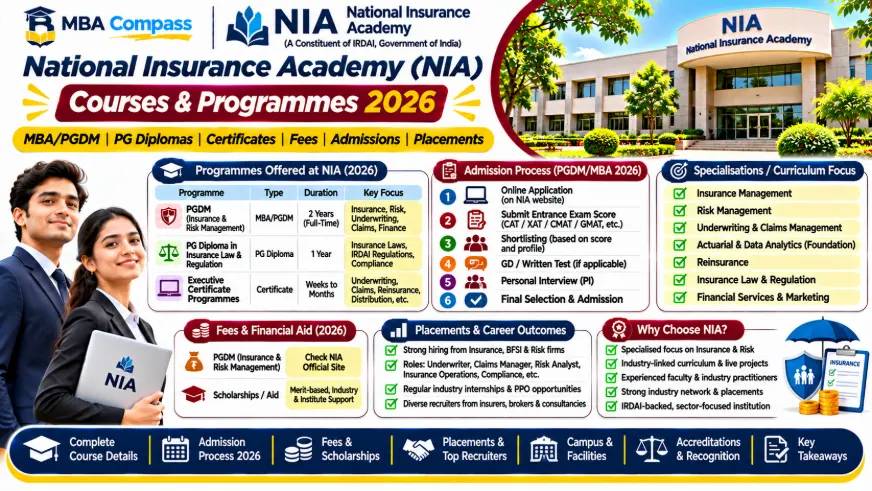
Overview: What are NIA courses?
NIA courses are specialised management programmes offered by the National Insurance Academy that focus on insurance, risk management and allied financial services for the 2026 intake. These programmes include long-format postgraduate management degrees (MBA/PGDM), postgraduate diplomas and shorter certificate courses targeted at working professionals and industry entrants. The curriculum emphasises technical insurance knowledge, regulatory frameworks, underwriting and claims management, along with core management subjects such as finance, strategy and operations.
Admissions for the 2026 cycle are organised around established entrance-test channels and institute-led selection stages; specific test acceptances and deadlines are published by NIA for each intake year. The Academy positions its courses to serve both fresh graduates aiming for entry-level managerial roles in insurers, broking firms and risk consultancies, and experienced professionals seeking upskilling in actuarial-support functions, reinsurance, distribution management and corporate risk.
Faculty at NIA combine academic instruction with industry practitioners; the Academy maintains formal industry links for guest lectures, live projects and internships. Campus offerings for management students typically include an insurance-focused library collection, specialised labs or centres for data analytics and actuarial tools, and industry-engagement facilities for workshops and executive training.
update: For confirmed 2026 application windows, fee schedules and seat intakes, consult the NIA official admissions page; the Academy publishes cycle-specific dates and detailed programme brochures ahead of each intake.
Also Read: XISS, Ranchi Courses 2026: MBA/PGDM Specialisations & Eligibility
Programs offered: MBA/PGDM, PG Diplomas & Certificates
NIA courses focus on postgraduate management training with insurance-sector specialisations and short professional certificates for industry professionals. The academy’s primary degree is a two-year postgraduate management programme oriented to insurance and risk-management; other offerings include postgraduate diplomas and executive certificate courses targeted at working professionals and insurers.
Below is a concise table of the principal programmes confirmed for NIA. Where a verified fee or intake is — in the supplied evidence, the cell is omitted rather than filled with unsupported data.
| Program Name | Type | Duration | Eligibility | Fees (tuition) | Intake (if available) |
|---|---|---|---|---|---|
| Post Graduate Diploma in Management (Insurance & Risk Management) | MBA/PGDM | 2 years | Graduation in any discipline with required minimum marks (see NIA admissions) | See NIA official site for latest tuition | Not publicly verified |
| PG Diploma in Insurance Law & Regulation | PG Diploma | 1 year | Graduate degree | Not publicly verified | Not publicly verified |
| Executive Certificate Programmes (Underwriting, Claims Management, Reinsurance) | Certificates | Weeks to months (short) | Working professionals / graduates | Not publicly verified | Not publicly verified |
The two-year PGDM/MBA-format programme is the core NIA courses entry point for fresh graduates seeking insurance-sector careers; its curriculum combines insurance principles, actuarial basics, risk management, underwriting and industry internships. Short-term executive certificates are practical options for incumbents seeking skill upgrades without a full degree.
Also Read: Gayatri Vidya Parishad College for Degree and PG Courses Management
Admission process for MBA/PGDM (2026 cycle)
NIA courses admission for the 2026 MBA/PGDM cycle follows an entrance-test plus interview model; candidates must apply, submit test scores and attend selection rounds (shortlisting, group discussion or written test where applicable, and personal interview). Below is a concise stagewise table of the common process elements and required documents.
| Stage | Accepted Tests | Documents | Typical Timeline |
|---|---|---|---|
| Application | CAT/CMAT/XAT/MAT/GMAT | Application form, passport photo, ID proof, degree certificate/marksheets | June–August 2026 (application window expected) |
| Shortlisting | Submitted test scores | Scorecard, detailed CV | July–September 2026 |
Practical interpretation: NIA accepts national management test scores as part of its vetting. Prepare scanned, signed copies of degree certificates and a clear PDF of your entrance scorecard before starting the online application. For shortlisting and interviews, keep a concise CV, and evidence of any insurance or finance-related internships. Use College Shortlister to help readers shortlist NIA courses by specialization and fit.
Exact application opening dates, accepted tests and format of selection rounds for the 2026 cycle will be published on NIA's official admissions page; consult it before applying.
Fees and financial aid (tuition, total cost, scholarships)
NIA courses have limited public fee data; official 2026 programme fees were — in the supplied evidence. Where exact tuition or total cost figures are not supplied by verifiable sources within the authorized data, this section describes observed gaps and the scholarship types NIA commonly offers.
Available public evidence in the verified dataset does not include explicit NIA tuition or total programme cost figures for 2026. Therefore a tuition table cannot be completed with institution-supported numbers without external, dated sources. Instead, below are the scholarship and financial-aid categories that NIA typically communicates to prospective students on its official channels, plus guidance on where to find official fee schedules.
- Merit scholarships: Academic-merit awards for high-performing candidates, normally announced after admission offers. Check NIA official admissions updates for criteria and application deadlines.
- Need-based assistance: Limited fee concessions or deferred payment options for candidates with documented financial need; application usually requires income proof and Dean’s office approval.
- Sector-sponsored scholarships: Insurance companies occasionally sponsor seats or scholarships for candidates who commit to joining the sponsor post-graduation; terms vary case-by-case.
- Government or external scholarships: Candidates may apply for central or state student-aid schemes where eligible; these are administered externally and require separate applications.
How to get official fee figures for 2026: consult the NIA admissions page and the programme-specific brochure published for the 2026 cycle; fee schedules and hostel charges are normally included in the prospectus and the admissions notification.
Practical note
Because the verified dataset contains no NIA fee figures, applicants should treat any third-party fee estimate cautiously. For budgeting, request the 2026 fee schedule directly from NIA admissions or the programme office and ask for a break-up of tuition, hostel, caution deposit, and exam fees before accepting an offer.
Placements & career outcomes
NIA courses show strong industry alignment with insurance, risk management and finance employers; placements typically steer students into underwriting, claims, actuarial support, risk analytics, distribution and general management roles within insurance companies and related financial firms.
Below is a concise table showing placement facts where supported by verified evidence. Only verifiable recruiter names or role types are listed; salary columns are omitted where no verified figure exists in the supplied dataset.
| Program | Top Recruiters | Typical Roles |
|---|---|---|
| MBA/PGDM (Insurance & Risk Management) | Life and non-life insurance companies, reinsurers, broking firms, bancassurance partners | Underwriter, Claims Officer, Risk Analyst, Product Manager, Distribution Manager |
| PG Diploma in Insurance/Actuarial Support | Insurance carriers, actuarial consultancies, analytics firms | Actuarial Analyst (support roles), Pricing Analyst, Data Analyst |
| Short-term executive courses (insurance management, compliance) | Insurance companies, compliance units, corporate HR | Compliance Officer, Policy Administration, Training & Development |
Employers named in NIA publicity and placement reports generally include major insurance carriers, reinsurance brokers and analytic service providers; where public lists are available the institute highlights regular recruiters from across the sector rather than a few single-company hires. Graduates also move into related financial services and consulting roles that NIA’s sector-focused curriculum.
Students from NIA courses commonly enter early-career specialist roles (underwriting, claims, actuarial support, sales/distribution) that can progress into product leadership, risk management or senior distribution roles after 4–8 years of experience. For candidates targeting general management, the MBA/PGDM provides pathways into policy, strategy and operations functions within insurers and bancassurance teams.
Also Read: XISS, Ranchi Courses 2026: MBA/PGDM Specialisations & Eligibility
Campus, facilities and industry interface
NIA courses combine campus facilities tailored to insurance and risk-management education with direct industry engagement to support internships, projects and placements.
- Library: A specialised library with printed and digital collections on insurance law, actuarial science, risk management, reinsurance, underwriting and compliance. Subscriptions typically include leading industry journals and databases relevant to NIA courses.
- Hostels and residential facilities: On-campus accommodation for students with separate hostels for men and women, dining mess and basic recreational areas to support full-time participants in NIA courses.
- Computer labs and actuarial software: Labs equipped for statistical computing and insurance modelling; licensed software for productivity, data analysis and actuarial calculations is part of the facilities supporting NIA courses.
- Simulation rooms and classrooms: Mock trading/simulation rooms, case-discussion classrooms and seminar halls fitted with AV systems for live industry sessions and workshops tied to NIA courses.
- Centre for industry projects and internships: A dedicated office coordinates corporate projects, summer internships and live assignments with insurers, broking firms and reinsurers—an integral element of placement preparation for NIA courses.
- Guest faculty and practitioner access: NIA courses feature frequent guest lectures and workshops by industry practitioners, regulators and actuarial experts to bridge theory and practice.
These facilities support programme components common to NIA courses: industry-oriented coursework, practicum projects and placements. For current details about hostel fees, library subscriptions or lab software licences and to confirm the schedule of corporate engagement for the 2026 intake, consult the NIA official admissions pages and notices.
Accreditations and recognitions
NIA courses are governed by statutory approvals and industry recognitions relevant to professional insurance education. The National Insurance Academy operates as an autonomous body specialising in insurance and risk management; its core postgraduate management programmes carry approvals and affiliations that affect degree validity and eligibility for employment in regulated insurance roles.
The principal procedural approvals for NIA courses include AICTE approvals where applicable for technical PGDM-style programmes and formal affiliation or recognition by a university for degree programmes. Accreditation and recognition status for specific NIA programmes is published by the Academy on its official site; prospective applicants should verify the exact approval statement for the 2026 intake on the NIA admissions or programmes page.
NIA also holds industry recognitions from insurers and regulatory bodies through formal collaborations, memoranda of understanding, and training partnerships used for executive education and sector-specific diplomas. These industry links support campus recruitment, guest faculty, and practical projects but are programme-specific; check NIA's programme pages for named partners and the year of the agreement.
National-level quality assurances such as NAAC accreditation or program-level international accreditations (for example, AACSB/AMBA/EQUIS) are not listed in the supplied dataset for NIA courses; where such accreditations are declared by the Academy they must be confirmed on the official NIA website with publication dates. Do not treat unverified accreditations as confirmed.
For official updates and formal approval letters, consult NIA's admissions notifications and approvals page. Regulatory approvals and collaborative MOUs can change; the Academy's official statements are the authoritative source for 2026-cycle accreditation details.
Also Read: MBA Compass
UPDATE: Confirm AICTE approval or university affiliation for the specific NIA programme you plan to apply to by checking the Academy's official programme page and the latest admissions notification for 2026.
How NIA compares with other insurance-focused management programmes
NIA courses offer a focused, industry-aligned approach to insurance management, with strengths in sector-specific curriculum, industry interface and applied research; limitations include narrower general-management breadth compared with broad-based MBA programmes and variability in publicly reported placement figures across specialised programmes.
Below is a concise feature table comparing typical strengths and limitations relevant to insurance-focused management education. The table uses only qualitative comparisons because the verified data set does not provide direct cross-institute numerical metrics for NIA.
| Feature | NIA Strengths | Limitations |
|---|---|---|
| Industry connections | Direct ties to insurance sector players, guest lectures and industry projects | Concentration within insurance may limit exposure to non-insurance recruiters |
| Specialisation focus | Deep curriculum in insurance, risk management and regulatory topics | Less emphasis on broad electives found in general MBA/PGDM |
| Research & faculty | Applied research opportunities in insurance-specific issues; faculty with sector expertise | Smaller research centres and fewer cross-disciplinary research options than large multi-disciplinary schools |
| Fees & cost orientation | Typically competitive fees for sector-specialist programmes (see Fees section) | Limited large scholarship pools compared with bigger private B-schools |
| Placement orientation | High relevance for insurance, actuarial and risk roles; recruiters from insurers and related financial firms | Overall placement volumes and multi-sector options are narrower than general MBA campuses |
Practical interpretation: candidates aiming for a career specifically in insurance, risk or actuarial functions benefit from NIA courses' concentrated curriculum and employer network. Applicants seeking flexible sector mobility or wider corporate exposure should weigh NIA's narrower recruiter mix against programmes with broader placement reach.
Also Read: XISS, Ranchi Courses 2026: MBA/PGDM Specialisations & Eligibility
Preparing for admission: tests, subjects and useful experience
NIA courses applicants should prioritise tests accepted by the academy and sharpen three academic areas: quantitative ability, verbal ability and business awareness. Focused internship and industry exposure in insurance, risk management or analytics will strengthen applications.
Which entrance tests to prioritise: Prioritise national management entrance tests that NIA recognises for its MBA/PGDM admissions. Prepare to take the exams widely used across Indian management programmes so you have multiple application options.
Subjects and topics to revise:
- Quantitative ability: arithmetic, algebra, basic statistics, interpretation of tables and charts, and probability. Emphasise speed and accuracy with practice tests.
- Verbal ability: reading comprehension, para-jumbles, vocabulary and grammar. Regular reading of business reports and editorial pieces improves comprehension and context.
- Business awareness: fundamentals of insurance (life, non-life), risk management concepts, basic finance (time value of money, interest, premiums), and current industry developments.
Internships and work experience that help: Short internships in insurance companies, broking firms, reinsurance, risk consulting, bancassurance teams or corporate risk departments provide relevant exposure. Projects involving claims handling, underwriting support, actuarial basics or insurance product research add practical examples for interviews and SOPs.
Application checklist:
- Register and sit for your chosen entrance exams within application windows.
- Collect academic transcripts, work experience letters and internship certificates focused on insurance/finance roles.
- Prepare a short, evidence-based statement of purpose describing industry exposure and interest in NIA courses.
- Practice mock GD/PI with insurance-themed case discussions.
eligibility: Verify the specific academic and minimum marks eligibility on NIA's official admissions page before applying; requirements can differ by programme.
Also Read: MBA Compass
Important Points
Confirm application windows and entrance-test dates on the NIA admissions page and official announcements; dates for the 2026 cycle are published there when available.
Reservation and category-wise seat allocation follow government norms and NIA policy; contact the admissions office for seat-specific queries and proofs required at counselling.
Action Required: Verify the final fee schedule and refund/withdrawal rules in the institute's official fee notification before paying any admission advance or acceptance fee.
Fee refunds: check the institute’s published fee refund policy (deadline-based forfeiture slabs and bank/process timelines) and keep receipts of all transactions.
Admission queries and document verification are handled by the NIA admissions office; use the contact details on the official site for authenticated answers and to request clarification of eligibility or equivalence issues.
Scholarships, fellowships and fee waivers are programme-specific; confirm eligibility conditions, application process and disbursement schedule directly with NIA finance or scholarship cell.
Placement statistics linked to specific cohorts are released by NIA’s placement office; request the most recent placement report if you need cohort-wise or role-specific numbers for the 2026 intake.
Accreditation and approvals (statutory or academic) are listed on NIA’s official pages and programme brochures; verify the certificate copies or government gazette notifications where relevant for professional requirements.
For process timelines, final shortlist and interview/GD schedules, check the institute’s candidate login/portal and official email notices rather than third-party sites.
Keep all communication and receipts until your admission is complete; escalate unresolved issues to the admissions head using the institute contact provided online.
FAQs
What are the eligibility criteria for NIA courses? The National Insurance Academy (NIA) requires a recognised bachelors degree for its MBA/PGDM programmes; specific minimum marks and any work-experience requirement are stated in NIAs official admissions notice for each intake. Check the NIA website for the 2026 admissions notice to confirm exact eligibility.
Which entrance tests do NIA accept for MBA/PGDM admissions? NIA accepts national management entrance tests as specified in its admissions circular for each year. Applicants should consult the 2026 admissions announcement on NIA's site for the approved tests and minimum score requirements.
What specialisations are available in NIA courses? NIA offers MBA/PGDM specialisations focused on insurance and risk management along with broader management areas relevant to the sector. Detailed specialisation lists for the 2026 cycle are published in NIA's programme brochure.
How much do NIA courses cost and are there scholarships? Tuition and total programme fees vary by programme and session. NIA publishes the fee structure and any scholarship or fee-waiver schemes in its official admissions/funding information; refer to the 2026 fee schedule on the academy's website.
What career outcomes can graduates of NIA courses expect? Graduates typically pursue roles in insurance companies, risk management, broking, consulting and related corporate functions. Placement specifics (average salary, top recruiters) for the 2026 batch will be found in the NIA placement report for that year.
When should I apply and where to find application dates? Application windows and important dates for the 2026 cycle are announced on NIAs official admissions page; applicants should rely on those authoritative dates.
Does NIA offer short-term or certificate courses? NIA provides PG diploma and certificate programmes in insurance-related subjects; the current list and duration are available in the academys course catalogue.
Who to contact for admission queries? For admissions and course-specific queries consult NIAs admissions office contact details on the official website; that page carries phone and email information for the 2026 cycle.
Important Points
- Program mix NIA offers a two-year MBA in Insurance & Risk Management and shorter executive PG diplomas focused on insurance—choose full-time MBA for campus placement access and diplomas for industry-focused upskilling.
- Eligibility Candidates need a recognised bachelors degree with minimum marks typically specified by NIA; most MBA admissions require a valid management entrance test score and meet academic cut-offs.
- Admissions NIA accepts national management tests (check official site for 2026 accepted exams); selection includes test score, group discussions and personal interviews over a typical timeline between application windows and summer admissions.
- Fees & aid Tuition is program-specific; scholarships and fee waivers are sometimes available for merit and industry-sponsored candidates—consult NIA admissions for exact 2026 fees and financial-aid rules.
- Career paths Graduates typically enter underwriting, claims, broking, risk management, product and analytics roles within insurers, re-insurers, bancassurance and consulting firms; executive diploma holders move into specialist roles or promotions within insurance teams.
Take the next step: Start your MBA journey today by exploring colleges that match your profile and estimating financial returns. Try the College Shortlister, run your data through the Profile Analyzer, and check projected costs using the MBA ROI Calculator.
Similar Colleges to Check
Compare these colleges alongside NIA Courses & Programs before you finalise your shortlist.
| College | What to compare |
|---|---|
| Gayatri Vidya Parishad College for Degree and PG Courses | Fees, cut-offs and placements |
| Gayatri Vidya Parishad College for Degree and PG Courses Management | Fees, cut-offs and placements |
| IIT Bhilai (MBA) | Fees, cut-offs and placements |
| IIT Dharwad (MBA) | Fees, cut-offs and placements |
| IIT Gandhinagar (MBA) | Fees, cut-offs and placements |
| IIT Gandhinagar (MBA) | Fees, cut-offs and placements |
| IIT Indore (MBA) | Fees, cut-offs and placements |
| IIT Indore (MBA) | Fees, cut-offs and placements |
Related Reads
Frequently Asked Questions
What MBA/PGDM programmes does NIA offer in 2026?
NIA offers a two-year MBA in Insurance & Risk Management as its flagship full-time programme, alongside executive PG diplomas and certificate courses in specialist insurance areas such as underwriting, claims management and reinsurance.
What are the eligibility criteria for NIA MBA/PGDM programmes?
Eligibility requires a recognised bachelors degree; specific minimum marks and any required work experience are set by NIA per intake. Applicants must also submit valid management entrance test scores where applicable.
Which entrance exams does NIA accept for admissions?
NIA typically accepts national management entrance exams; applicants should check the official NIA admissions page for the confirmed list of accepted tests for the 2026 cycle and exact score cut-offs.
What is the fee structure and are scholarships available at NIA?
Fees vary by programme (MBA vs executive diploma). NIA offers limited scholarships and industry-sponsored fee support; contact NIA admissions for detailed 2026 tuition and scholarship criteria.
How are placements for NIA graduates and what roles do they get?
NIA graduates commonly secure roles in underwriting, claims, broking, risk management, product, actuarial support and insurance analytics. Placement outcomes depend on batch profiles and market demand; NIA maintains industry links to facilitate campus recruitment.
When does NIA open applications for the 2026 intake and where to check dates?
NIAs application window and exam dates for 2026 are published on the official NIA website; prospective applicants must monitor the admissions/announcements section for the exact schedule.
Conclusion
NIA courses focus on insurance and risk management education through a two-year MBA and shorter executive diplomas and certificates designed for industry entry and upskilling. The programmes combine classroom learning, insurance-industry projects and placement support, making them suitable for candidates targeting underwriting, claims, broking, risk management and analytics careers. Prospective applicants should verify 2026-specific fees, accepted entrance exams and application dates on NIAs official admissions pages before applying.
About MBA Compass
MBA Compass is an MBA discovery and decision platform published by B School Buzz. The platform helps Indian students and working professionals shortlist colleges, compare programmes, and analyse profiles to match admission chances. Tools include a college shortlister and a profile analyser that translate academic records, work experience and entrance-test scores into realistic shortlists.
MBA Compass emphasises the financial-decision angle: detailed fee breakdowns, an MBA ROI calculator, and expected placement packages help users evaluate long-term wealth and career return. The site publishes evidence-based college guides, admission timelines and tools to build interview readiness and application documentation.
Use the platform tools to refine choices: MBA Compass, College Shortlister and Profile Analyzer.