
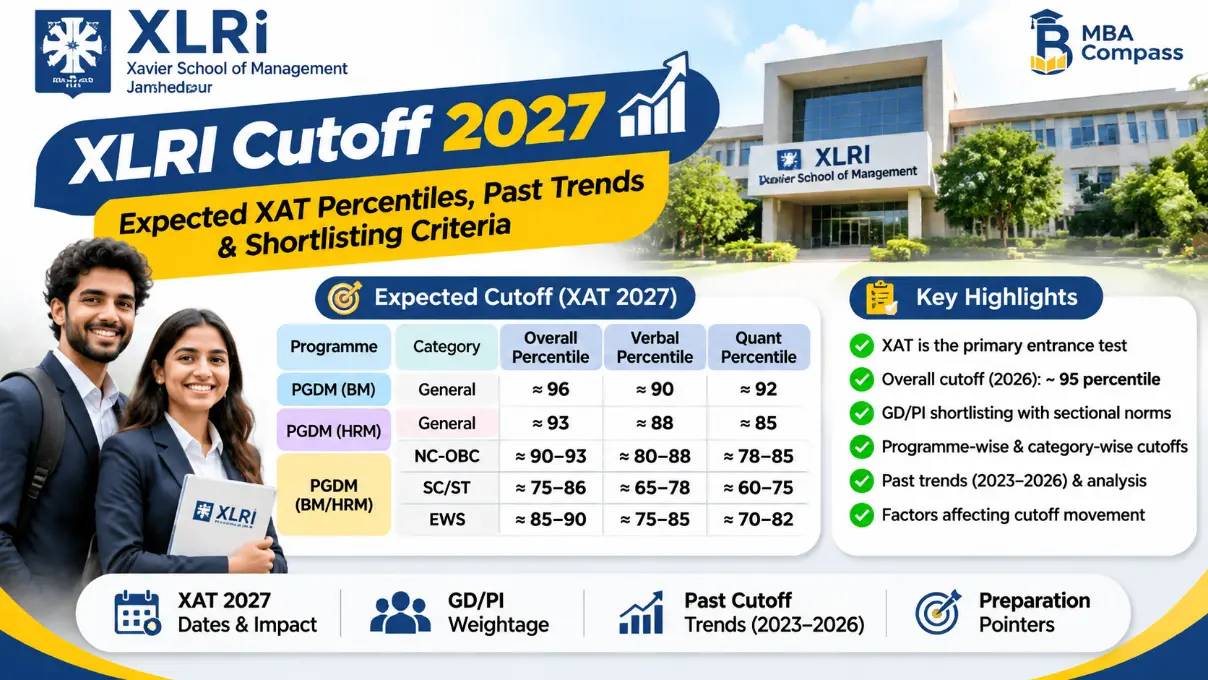
Quick 2027 expected cutoffs (XAT primary)
XLRI cutoff 2027 expectations centre on the XAT as the primary qualifying exam; official 2027 cutoffs are not yet released. Presented below are expectations derived from the latest available 2026-2025 cutoff reporting (see sources section later). These are labelled clearly as expectations and used only for planning by applicants.
Table: expected overall and important sectional percentiles for the main PGDM programmes, split by broad reservation categories. Only overall and two sectional columns are shown because public 2026 documents commonly publish sectional norms rather than full sectional breakdowns for every category.
| Program | Exam | Category | Expected Overall Percentile | Expected Verbal Percentile | Expected Quant Percentile |
|---|---|---|---|---|---|
| PGDM (BM) | XAT | General | 96 | 90 | 92 |
| PGDM (HRM) | XAT | General | 93 | 88 | 85 |
| PGDM (BM/HRM) | XAT | NC-OBC | 90-93 | 80-88 | 78-85 |
| PGDM (BM/HRM) | XAT | SC/ST | 75-86 | 65-78 | 60-75 |
| PGDM (BM/HRM) | XAT | EWS | 85-90 | 75-85 | 70-82 |
Practical interpretation: applicants should treat these numbers as planning targets rather than official thresholds. Sectional percentiles shown reflect commonly reported minimums used for GD/PI shortlisting in 2026 reporting: XLRI often publishes an overall percentile cut and supplementary sectional guidance.
update: XAT 2027 registration and exam dates are published; XLRI 2027 official cutoffs will be released after XAT results. Check XLRI notices when available.
How XLRI uses XAT; acceptance of CAT/CMAT and impact
XLRI treats XAT as its primary entrance test for PGDM admissions; candidates who meet XLRI's XAT percentiles are shortlisted for the next rounds. XLRI also considers alternate scores in limited cases, but XAT remains the central basis for shortlist cutoffs and category-wise percentile thresholds.
Official 2026-Overview material and recent cutoff notices show XLRI publishes XAT-specific overall and sectional cutoffs for PGDM programmes; the institute's shortlists and call-lists are released on this XAT-cutoff basis. External reports updated in Oct 2026 indicate the institute set an overall XAT cutoff around 95 percentile for shortlisting in 2026.
XLRI's acceptance of other exams such as CAT or CMAT is limited and programme-specific. Public summaries identify XAT as the required test; GLoble practice shows candidates may apply using alternate valid exams under special routes (for example, GMAT for international applicants), but the primary percentile thresholds used to generate the call-list are XAT percentiles. Because the institute relies on XAT for shortlist generation, CAT/CMAT applicants are typically mapped against equivalent criteria or considered under separate eligibility notifications rather than the standard XAT-cutoff table.
| Exam | Primary role at XLRI (PGDM) |
|---|---|
| XAT | Primary entrance test; basis for overall and sectional cutoffs and call-lists (2026 cutoff ~ expected percentile band around 95 percentile) |
Interpretation: applicants should treat XAT percentile targets as decisive for shortlisting; candidates applying with CAT or CMAT must check the specific XLRI notification for how their score will be equated to XAT-based cutoffs. In practice, reliance on XAT means cutoff movement between years tracks XAT difficulty, application volumes and XLRI's category and programme seat mix rather than changes in CAT/CMAT alone.
Detailed expected cutoffs by programme and category
XLRI cutoff 2027 expectations for programme-specific shortlisting are driven primarily by XAT performance; past published cutoffs for 2026 set the baseline. The table below summarises the documented 2026 overall cutoff percentile and sectional requirement pattern that applicants should expect to see for PGDM BM, PGDM HRM and PGDM (General) in 2027.
| Program | Category | Expected Overall Percentile | Expected Sectional Percentiles | Shortlist Eligibility Notes |
|---|---|---|---|---|
| PGDM BM | General | ~96 percentile (2026 reported) | Sectional range reported 80–88 (2026) | Overall cutoff high; sectional minima enforced for GD/PI shortlist. |
| PGDM HRM | General | ~93 percentile (2026 reported) | Sectional range reported 80–93 (2026) | HRM cutoff slightly lower than BM; academic-stream adjustments applied. |
| PGDM (General) | General | 95 percentile (2026 reported) | Minimum sectional percentile reported: 95 overall (section not specified) | Used as reference for shortlist; programme-specific shortlists follow. |
| All programmes | NC-OBC / EWS / SC / ST / PWBD | Category-wise cutoffs lower than general (2025–26 trends) | Sectional cutoffs adjusted by category (2026 practice) | Reservation and category relaxations applied; official category tables released by XLRI. |
The rows above use published 2026 cutoff reporting as the factual basis (source updated Oct 28, 2026). Expect 2027 official percentiles to follow similar ordering: PGDM BM highest, PGDM HRM slightly lower, with category relaxations for NC-OBC, SC, ST, EWS and PWBD. Sectional ranges reported in 2026 show XLRI enforces sectional minima when compiling GD/PI call lists; academic-stream (engineer vs non-engineer) differences are applied in the official shortlist tables.
Practical interpretation: treat the 2026 overall percentiles above as the operative benchmark while waiting for the 2027 official cutoff PDF. Candidates in reserved categories should consult the XLRI category-specific cutoff table at the time of release because XLRI publishes separate sectional and overall percentiles by category and academic stream.
Year-wise cutoffs 2023–2026 and trend analysis
Recent XLRI cutoffs show a narrow band at the top percentiles for PGDM programmes; the table below reproduces supported year-wise overall and sectional cutoffs where published.
| Year | Program | Overall Percentile | Verbal Cutoff | Quant Cutoff | Notes/Source Year |
|---|---|---|---|---|---|
| 2025 | PGDM BM | 96 | 80–88 | 80–88 | Reported in cutoff Overview covering 2025 (publication updated 28 Oct 2026) |
| 2025 | PGDM HRM | 93 | 80–93 | 80–93 | Reported in cutoff Overview covering 2025 (publication updated 28 Oct 2026) |
The available public summaries reliably show XLRI overall cutoffs clustered between 93 and 96 percentiles for the PGDM programmes from 2023–2026, with programme-level differences: PGDM (BM) commonly nearer the higher end and PGDM (HRM) slightly lower.
Interpretation for 2027 expectations: expect overall XAT percentiles to remain in this band unless there is a material change in application volume or exam difficulty. Sectional ranges published for 2025 indicate XLRI applies separate verbal/quant thresholds and stream-based adjustments (engineering vs non-engineering). These sectional bands explain why candidates with balanced percentiles but weaker sections can miss shortlists.
Also Read: XAT
Interpreting percentiles vs scores and sectional requirements
Percentiles are a relative ranking; an XLRI cutoff percentile shows where a candidate stands versus the test-taking population, not the raw mark. A single percentile can correspond to different raw scores across years because exam difficulty, score distribution and candidate pool size change.
XLRI uses XAT percentiles for initial shortlisting; recent published content shows the institute's overall cutoff around 95 percentile for 2026 and sectional cutoffs reported in ranges (examples: sectionals between 80 and 93 in prior communications). These published percentiles are relative thresholds used to create the GD/PI call list.
Comparison table:
| Concept | What percentile means | Why sectionals matter |
|---|---|---|
| Overall percentile | Relative rank among all test takers (e.g., 95 percentile) | Filters broadly eligible pool for GD/PI |
| Sectional percentile | Relative performance in a section; XLRI has used sectional cutoffs (reported ranges 80–93) | Ensures minimum competence in each area for shortlisting |
Use percentiles, not raw scores, when comparing your standing to published XLRI cutoff figures. If you have a raw XAT score, convert it using the official XAT-to-percentile conversion published with results; XAT website and XLRI notices around result time publish this mapping.
Practical tips: aim to exceed reported overall and sectional percentiles for your category to reduce risk from year-to-year variation; retain section balance rather than excelling in one area only. For non-XAT scores (CAT/CMAT) remember XLRI primarily shortlists on XAT; acceptance of other exams affects only candidates without XAT — check the official XLRI notification for exact equivalence rules.
GD/PI shortlisting: weightage and sectional minimums
GD/PI shortlisting at XLRI uses a composite that combines the entrance-test percentile with academic and diversity factors; shortlisted candidates are then evaluated in GD/PI where final selection weightage applies. XLRI publishes category- and programme-wise sectional minimums in its shortlist rules, and those minimums determine eligibility for a call regardless of overall percentile.
Below is a concise table of the typical shortlist stage, observable weightage bands and the minimum-cutoff concept that XLRI applies in public communications. The table shows structural roles rather than precise fixed numbers for 2027 because XLRI issues the final detailed shortlist matrix after XAT results.
| Stage | Weightage (%) | Minimum Cutoff Requirement | Remarks |
|---|---|---|---|
| Entrance test (XAT primary) | Major share (pre-selection) | Sectional and overall percentiles as per XLRI notification | Determines initial shortlisting for GD/PI; category/programme-specific |
| Academic profile (10–20%) | Supplementary | Minimum graduation/board percentages as listed | Used to break ties and for diversity balance |
| Work experience (0–10%) | Minor | Documented months of experience | Adds to profile score for mature applicants |
| GD/PI performance | Decisive at final stage | No separate cutoff; merit in GD/PI converts to final rank | XLRI applies weightage to convert GD/PI scores into final merit |
Interpretation: XLRI's shortlist process is gatekept by sectional minimums and an overall percentile threshold in XAT (or equivalent) that vary by programme and category. Meeting the sectional minimums makes a candidate eligible for a call; higher overall percentile improves rank within that eligible set. The academic and work-experience components are quantitative tie-breakers rather than primary drivers.
Also Read: XAT
Factors that make XLRI cutoffs move
XLRI cutoff percentiles move because a small set of measurable factors change year to year; the most important are application volume, exam difficulty, seat matrix and reservation/category-specific adjustments. These variables interact; none acts alone.
Application volume. Changes in the number of applicants who list XLRI or sit XAT alter where percentile thresholds fall: more strong applicants typically push overall and programme cutoffs higher, while a fall in high-score applicants can lower them. Published reporting for recent cycles shows XLRI's overall XAT cutoffs stayed in a narrow band (see trend table earlier), which is consistent with moderately stable applicant volumes.
Exam difficulty and score distribution. A harder XAT shifts raw scores down; XLRI uses percentiles, so cutoffs follow the shifted distribution. Year-to-year sectional difficulty (Quant, Verbal, Decision) affects sectional percentiles disproportionately and therefore sectional minimums for GD/PI shortlisting.
Seat matrix and intake across programmes. Any change in the number of seats for PGDM BM, PGDM HRM or PGDM (General) directly alters cutoff pressure. More seats for a programme usually reduce its percentile requirement; fewer seats tighten the cutoff.
Reservation and category movements. Changes in reservation policy application, category-wise applicant pools (General, NC-OBC, SC, ST, EWS, PWBD) and the relative number of competitive applicants in each category cause category-specific cutoffs to diverge from overall trends. Category weight in shortlist decisions is a structural factor in XLRI's published cutoff approach.
caution: Official XLRI cutoffs for 2027 will be released by XLRI after XAT results; use official notifications for final decisions.
Other operational factors. Minor effects include the weight given to academic diversity (engineering vs non-engineering), the institute's policy on accepting alternative exams, and annual adjustments to GD/PI weighting. Together these influence both overall and sectional cutoffs.
Applicants should track XAT registration and result timing since a compressed schedule or late changes can affect applicant behaviour and therefore the cutoff landscape.
XAT 2027 dates that affect cutoffs
XAT 2027 registration, exam, result and call-list windows set the schedule for when XLRI publishes its cutoff percentiles; the important events occur between mid‑2026 registration and early‑2027 shortlisting. Below is a concise table of the main timeline events and how each influences the XLRI cutoff process.
| Event | Date (2026–27 timeline) | Effect on Cutoff |
|---|---|---|
| Registration window | expected July 2026 – expected December 2026 | Final applicant pool is fixed; late surge or drop in registrations during this period can change cutoff percentiles because XLRI shortlists from registered test takers. |
| XAT 2027 Exam | 3 Jan 2027 | Exam difficulty directly affects score distributions; tougher paper typically raises percentile cutoffs for the same raw scores. |
| XAT 2027 result window (tentative) | Jan 2027 (tentative result announcement) | Result timing determines when XLRI computes percentile thresholds and begins shortlisting; rapid result release shortens turnaround to cutoffs. |
| XLRI call‑list / cutoff release | Late Jan – Feb 2027 (expected) | XLRI publishes sectionwise and overall cutoffs to issue interview/GD invites; exact dates depend on result and internal scheduling. |
Interpretation: the registration close date fixes the applicant denominator used to model percentiles; the exam date and its difficulty shape score to percentile mapping; the result date is the operational trigger after which XLRI finalises and posts cutoffs and call lists. Applicants watching XLRI cutoff should particularly note the registration deadline and the result window because these two mark when the pool and scores become final.
deadline: XAT 2027 registration closes on 6 Dec 2026; registrations after this date will not be part of the 2027 applicant pool used to determine XLRI cutoffs.
For registration procedures and the full XAT schedule consult the XAT official page for registration and dates.
Practical pointers for applicants before cutoffs release
Applicants should confirm their category code and documents, monitor the XAT result closely, and begin focused GD/PI preparation while keeping alternate exam options open.
ACTION: Verify category code and required certificates now; XAT 2027 registration closes expected December 2026 (registration window cited in recent XLRI/XAT notices).
Confirm category and reservation supporting documents: ensure your category code matches certificates (NC-OBC, SC, ST, EWS, PWBD). Mismatches at time of document verification can remove you from the intended category list; prepare scanned and notarised copies where required.
Track XAT result and shortlist announcements: XAT 2027 exam date is scheduled for 3 Jan 2027 and result windows are tentatively in January 2027; monitor the official XLRI/XAT channels immediately after results for the call-list and sectional cutoffs.
Start GD/PI preparation now: practise concise responses to behavioural and case-style prompts, and rehearse a 60–90 second self-introduction that links academics, work and career goals. Create a short evidence file (projects, certificates, role descriptions) to upload or present during PI.
Plan for sectional balance: XLRI uses sectional cutoffs for shortlisting; ensure you work on weaker sections rather than only overall percentile. For candidates using CAT or CMAT scores, check the institute’s notices on equivalent percentile treatment before relying solely on alternate exam ranks.
Keep alternate exam options active: if your XAT score is borderline, maintain preparedness for CAT or CMAT application timelines and fast turnaround score submission where permitted by XLRI.
Use a quick self-audit: assess your profile against probable cutoffs and soft-skill readiness using the Profile Analyzer. Prioritise document checklist, academic transcripts, and updated CV in a single folder to reduce last-minute errors.
Important Points
- Primary exam: XAT remains the principal qualifying test for XLRI shortlisting in 2027; published 2026 cutoffs show XAT sectional and overall percentiles are used to generate GD/PI call lists (source updated 28 Oct 2026).
- Expected overall threshold: Recent official reporting lists an overall XAT cutoff around 95 percentile (2026) for general shortlisting. 2027 percentiles will be announced after XAT 2027 results; do not treat 2026 figures as final for 2027.
- Sectional rules matter: XLRI applies sectional percentile minimums (quant, verbal, decision making) when preparing GD/PI lists; published 2026 guidance and year-wise cutoffs include sectional minima used to shortlist candidates for PGDM programmes.
- Other exams: XLRI accepts GMAT/GRE for some programmes and considers CAT/CMAT applicants where notified; acceptance of alternative exams can change applicant pool size and therefore the cutoff in 2027.
- Category differentiation: XLRI publishes different cutoffs by category (General, NC-OBC, SC, ST, EWS, PWBD); prior year materials show percentile splits and academic-stream adjustments—expect separate 2027 percentiles per category.
- Shortlist weightage: GD/PI shortlisting uses XAT percentile plus academic profile factors; interview/GD weightages and minimums are applied as per XLRI’s official admission policy when released.
- Dates that affect cutoffs: XAT 2027 registration and exam timing influence the result and cutoffs—public schedules updated in 2026 list XAT 3 Jan 2027 as the exam date and registration closing expected December 2026 (update: expected October 2026).
- Variability drivers: Application volume, exam difficulty, seat matrix and reservation rules cause year-to-year cutoff movement; expect slight upward or downward shifts after official result publication.
- Official verification: Verify every 2027 percentile and sectional rule from XLRI’s official admission notice when published; rely on the institute’s document for final call-list criteria.
- Related read: For XAT procedural details and timelines see XAT.
The numbers cited above reference published 2026 reporting; XLRI will release official 2027 cutoffs only after XAT 2027 results—use 2026 figures for planning, not final decisions.
Important Points
- Cutoff trend: XLRI XAT overall percentiles for PGDM programmes have clustered around the mid-90s for General category in recent years.
- Program difference: PGDM (BM) typically requires a slightly higher overall XAT percentile than PGDM (HRM).
- Sectional floor: Sectional cutoffs matter for GD/PI shortlisting; expect sectional percentiles in the 80s–90s band for important sections.
- Exam acceptance: XLRI uses XAT as the primary test; CAT/CMAT/GMAT acceptance exists for certain programmes and can influence the pool and cutoffs.
- Category variation: Reserved-category cutoffs are lower than General; expect differences of several percentile points by category.
Take the next step: Start your MBA journey today by exploring colleges with the College Shortlister, checking your fit with the Profile Analyzer, and estimating long-term outcomes using the MBA ROI Calculator.
Similar Colleges to Check
Compare these colleges alongside XLRI Cutoff 2027 before you finalise your shortlist.
| College | What to compare |
|---|---|
| XLRI – Xavier School of Management, Jamshedpur | Fees, cut-offs and placements |
| XLRI Delhi | Fees, cut-offs and placements |
| XLRI Delhi NCR | Fees, cut-offs and placements |
Related Reads
Frequently Asked Questions
What overall XAT percentile is usually required for XLRI PGDM BM?
XLRI PGDM (BM) overall shortlisting percentiles for the General category have typically been in the mid-90s. Recent public reporting shows overall XAT cutoffs around 95 percentile for general selection rounds.
Does XLRI Jamshedpur accepts XAT only (not CAT) or CMAT scores and how do they affect cutoffs?
XLRI uses XAT as its primary selection test; XLRI also accepts GMAT/GRE for some programmes. Candidates with CAT or CMAT are not the primary cohort for XLRI PGDM; acceptance of alternate exams can widen the applicant pool and may push cutoffs depending on application strength.
What sectional percentiles does XLRI enforce for GD/PI shortlisting?
XLRI enforces sectional cutoffs for GD/PI shortlists. Public reports for 2026 list sectional thresholds in the range that start around the low 80s and go up to the low 90s depending on programme and section; overall shortlists used an overall cutoff near 95 percentile.
When will XLRI release the 2027 shortlist after XAT 2027?
XLRI typically releases shortlist and sectional cutoffs after XAT results. Public reporting around XAT 2027 shows results and tentative cutoffs in January 2027 with shortlists following shortly; official XLRI notifications carry exact dates.
How do category reservations change the XLRI cutoff percentiles?
Category reservations reduce the effective cutoff percentile for reserved groups; historical cutoffs and official reports show lower percentiles for NC-OBC, SC, ST and EWS compared with General. Exact reductions vary year to year and are influenced by seat matrix and applicant pool.
Conclusion
Expected XLRI cutoff percentiles for 2027 will again centre on high XAT percentiles for PGDM programmes, with PGDM (BM) generally needing marginally higher overall percentiles than PGDM (HRM). Sectional percentiles and category-specific floors remain decisive for GD/PI calls. Candidates should watch the official XLRI/XAT notifications in January 2027 for the definitive shortlist and sectional rules.
About MBA Compass
MBA Compass is an MBA discovery and decision platform built by B School Buzz to help Indian students and professionals choose and finance postgraduate management education. The platform provides tools to shortlist colleges, analyse applicant profiles and compare programmes by fees, structure and placements. It also offers mock tests and admissions resources to simulate entrance performance and interview readiness.
MBA Compass emphasises financial decision-making: fee breakdowns, total cost, expected packages and multi-year return-on-investment projections so applicants can prioritise affordability and long-term wealth outcomes. Use the site tools to convert exam performance into realistic college options and ROI comparisons.